Sustainability Action Plan
To my dear colleagues at Breathe,
This is a letter to you. It sets out what the problem is, and, as an organisation what we need to do about it, what we need to take responsibility for.
Since completing our 2022 Sustainability Action Plan we are pleased to see much needed progress in the industry towards more sustainable practices. These gains are the beginning of what needs to be a long and sustained transformation of the industry. We have recently observed a growing misconception within the industry, however, that the job is now done. As an internationally-recognised Australian sustainability rating and certification system, Green Star has come a long way. It’s also fair to say the profession is upgrading its sustainability literacy. There are also some good policies that have been signed into law. Some think that means mission accomplished.
Sadly, reality tells a very different story. Government’s ‘sensible, practical approach’ to climate action means that our current projections show us soaring past our 2035 emissions reduction target. We are on track to cut climate pollution by only 48 per cent below 2005 levels by 2035. This is a major shortfall on what was already a compromised target reduction of between 62 and 70 per cent.
We face the double jeopardy of failing to meet our carbon targets while growing complacent that we’ve done enough. In the face of this double jeopardy, we at Breathe need to double down on sustainability. We need to do more.
This is the purpose of updating our 2022 Sustainability Action Plan. To strengthen key aspects of our four core 2022 Sustainability Action Plan goals while expanding these goals to meet the scale and urgency of the challenge ahead.
The Why
The Climate Gap
Global warming has not stopped growing. We continue to break all the wrong records. Recent years has given us a taste of what it means to reach +1.5C. Increasing heatwaves, floods, and storms are occurring within weeks of each other, and at a higher frequency than ever. As we are already at or near the Paris Agreement ceiling, and we are heading towards +2.8-3C, things are only going to get worse. Climate science data and modelling suggests that this threshold, when breached, may lead to several ‘runaway effects’ and positive feedback loops, with unfathomable consequences. This is obviously urgent news for our earth’s capacity to regulate its temperature and weather conditions.
For Australia to do its bit, the Climate Council recommends that we target reduced emissions of 75 percent below 2005 levels by 2030 and reach net zero by 2035. That gap, between a responsible target and Australia’s current policies, means we need to exceed minimum standards. If we take climate seriously, we need to push our own ambition harder than ever.
Our Dirty Industry
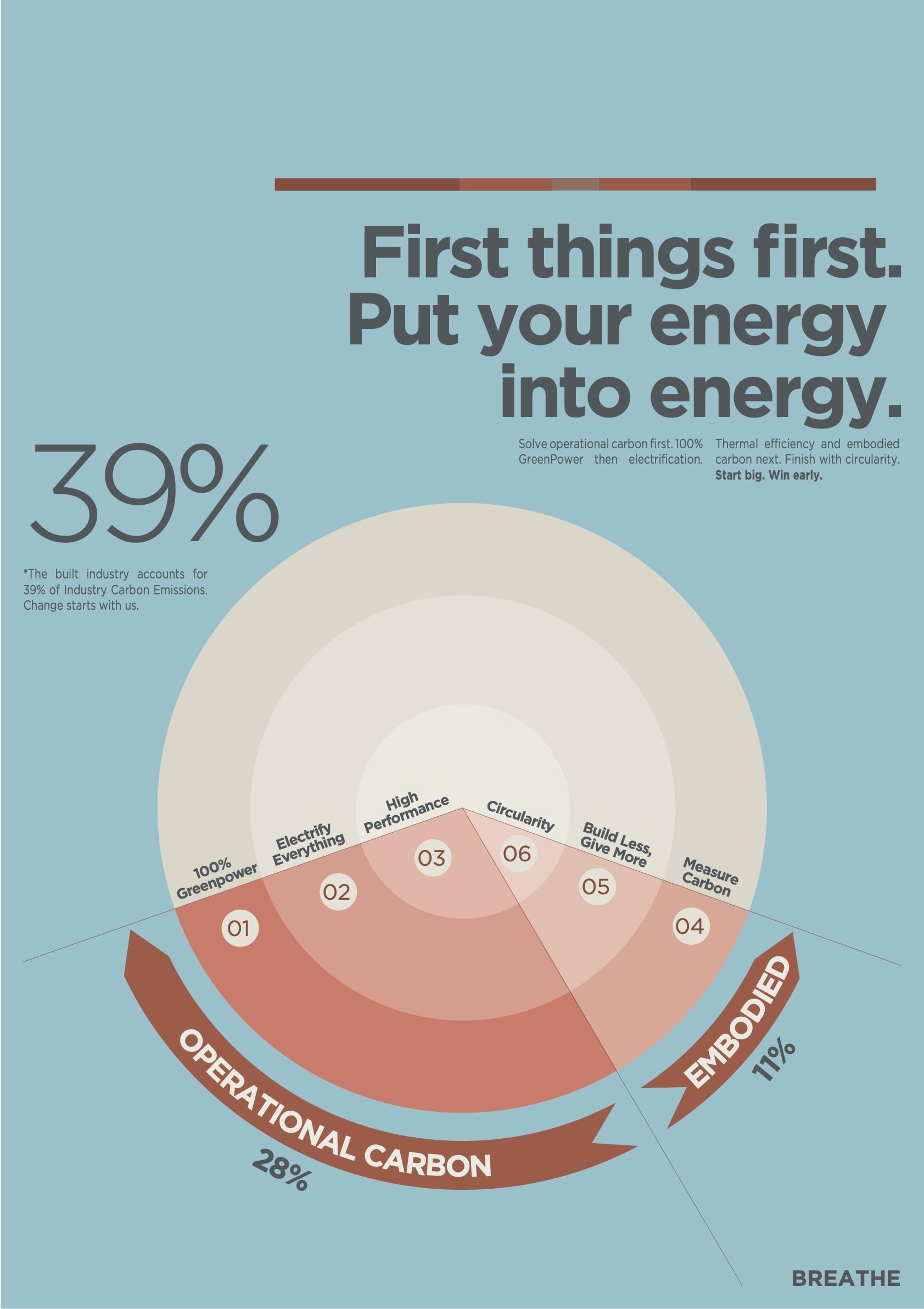
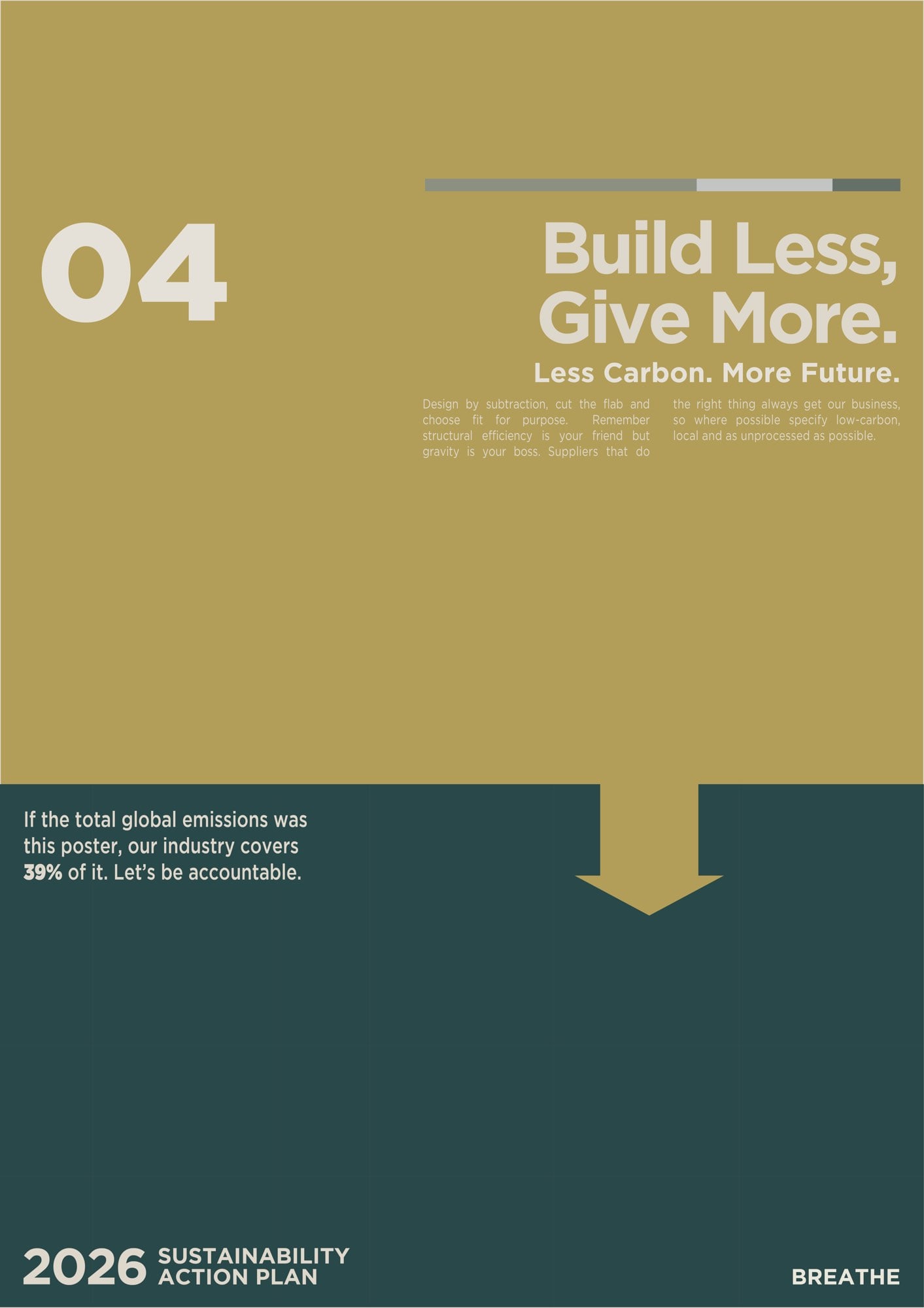
The construction industry is one of the worst polluters in the world. Its emissions are up there with energy, industry and transport. Combining both embedded carbon emissions from construction, and operational emissions for building use, the industry is responsible for a total of 39% of all the world’s carbon emissions. The stark reality is that if we are part of an industry that wants to build a sustainable future, we must face up to our significant responsibility. Not a bit part. A starring role. We must do better.
How much better? According to the Australian Reduction Roadmap, which reviewed carbon emissions related to housing, business as usual construction results in 461 kilograms of carbon dioxide equivalent per square metre per year. Tracking Australia’s housing needs, if we continue that rate of emissions, our future housing will equate to 200% of our national emissions budget for everything, just on those new houses. The report’s bottom line estimates that we need to reduce emissions by 98% per square metre. That wasn’t a typo. 98%.
Looking more broadly at waste in the industry, multiple research sources indicate that the construction sector involves a high volume of general waste produced through the delivery of buildings and infrastructure. Different data sets point to between 20 and 40 percent of all materials delivered to site end up in a skip. These energy and carbon-intensive practices are still embedded in the work that we do.
More with Less
70% of the world’s population will reside in cities and urban areas by 2050, bringing with it the spectre of increased consumption and levels of emissions. Melbourne is a leader in this growth trend. It is expected to be the largest city in Australia by 2070 with a projected population that could reach 10 million people.
This leads to increasing pressure to build homes and infrastructure for our cities at rates that will accelerate, not reduce, ecological damage to our natural systems. Urban sprawl, air pollution, congestion and depleted public spaces will all just get worse, without a serious plan.
Biodiversity
One of the most important lessons we have learned from Traditional Custodians, is that sustainability is not only a human imperative. A healthy environment is also healthy for our non-human kin. Here we are failing tragically. Many native species have been driven to extinction, and many more are threatened with increased risk of extinction due to the impacts of climate change, habitat loss, a rise in invasive species and many other threats.
In Victoria alone, over 50% of native vegetation has been removed during the two centuries since European settlement. The Environment Protection and Biodiversity Conservation Act 1999 currently lists nearly 2,000 species as threatened with extinction across Australia, while in Victoria, the Victorian National Parks Association estimates that over 50 species of animals and plants have already disappeared from the state forever. Urban expansion, alongside intensive resource extraction, in the form of agriculture, mining and deforestation, means that a once rich and diverse biodome is not just under threat of depletion. The damage to our environment is real, on-going and expanding.


Our Approach
100% Greenpower
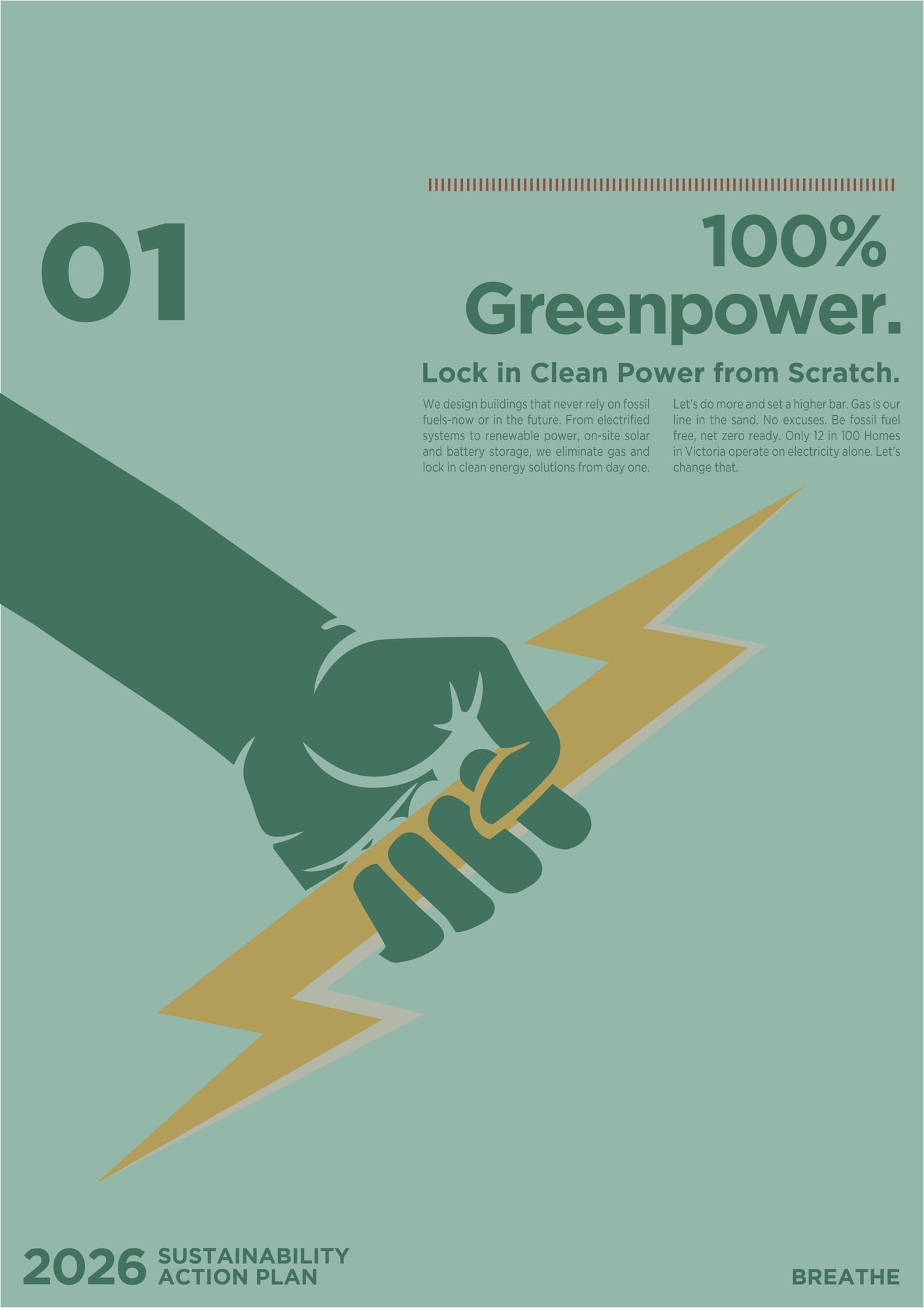
The large majority of the built environment’s carbon footprint is in the energy used for hot water, heating and cooling, lighting and power. Much of that power is sadly generated from dirty coal. The good news is that this has an easy fix. It is your role to educate, to advocate with your clients to make the switch to 100% GreenPower, every time. In most cases it’s as simple as helping a client call their energy provider and opt in for 100% GreenPower. Clean energy is no longer niche, but is a growing sector of the energy market. With our help it will become the only sector.
The two other clean power options are onsite solutions: solar energy and batteries. Where solar is an option, it should be baked-in, to optimise your design to accommodate a solar array. Studies estimate there is potential for 60.9 GW of rooftop solar potential on residential buildings—four times more than the 15 GW estimated to be installed to date.
Remember, ‘energy sovereignty’ is thinking small. Think big. Aim for 120% of your expected needs, to both future proof against increased energy consumption and to feed excess into the National Energy Grid. Virtual Power Plants (VPP) can help here, and should be advocated for as providing both financial benefit and the benefit of decarbonising the grid. Exporting electrons can help pay down your carbon debt over time. The only way to get to Net Zero.
Payback on a Solar battery is now down to 4 years (that’s half the payback from just five years ago). So now is the time to invest in on site storage. This too needs to be sized at 120% of expected energy storage demand if we are to help our clients to seriously participate in a VPP solution, which helps deliver price certainty and protect your client and building occupants from rising energy prices. Not an afterthought, but as a core commitment to sustainable living, and cheaper costs.
Electrify Everything
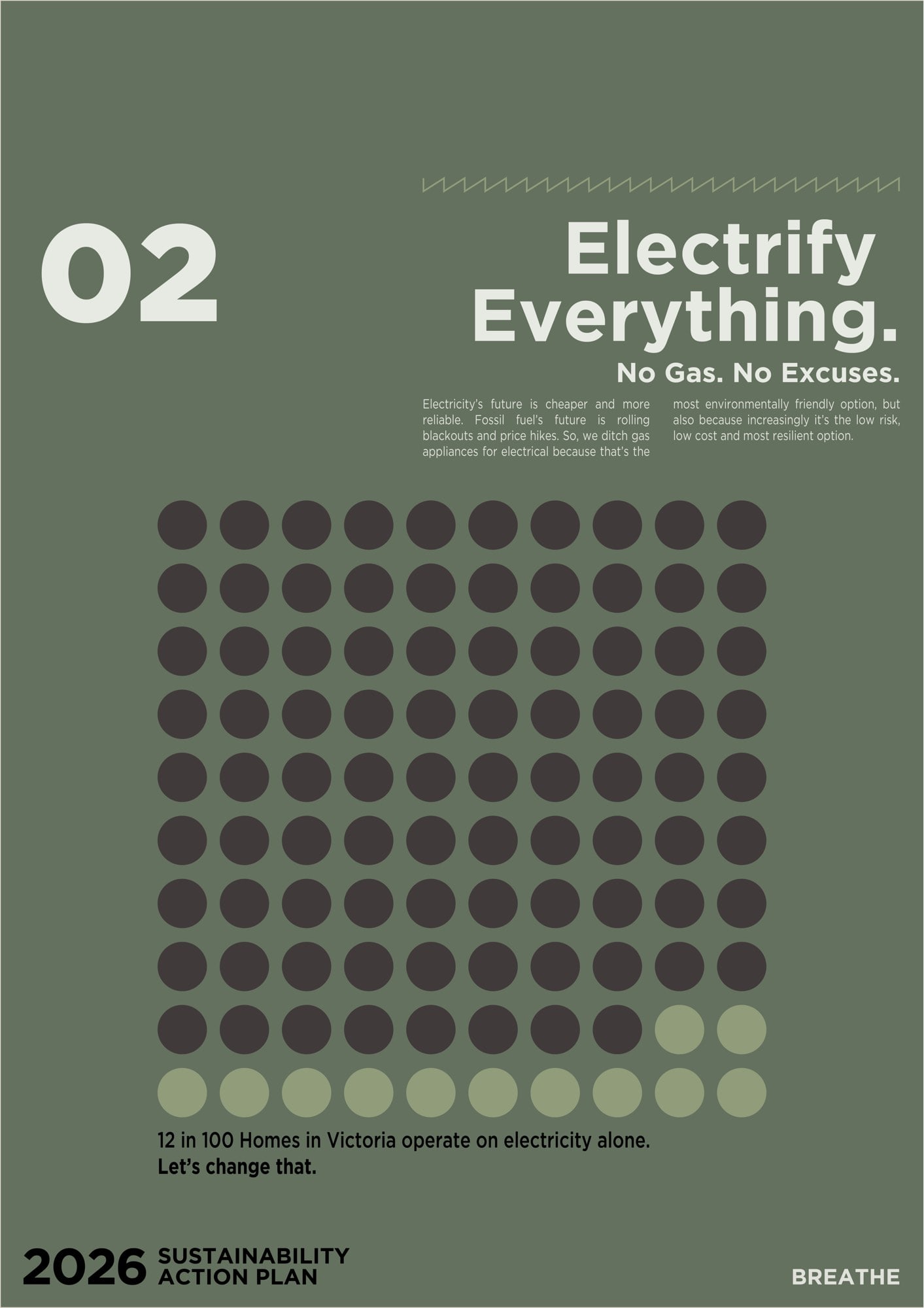
With GreenPower locked in, it’s time to shift from energy supply to energy use. The future is electric, so zero gas appliances is a baseline, not an aspiration or a target. Electrify everything.
If you work on a project outside of Victoria or the ACT it is your job to advocate for and educate your clients on the benefits of electrification from the very first meeting. Lead with cost, risk and uncertainty. Get the quantity surveyor on side early. The client might not know how to measure climate benefits, but the QS will have clear views on the reduction of cost of gas reticulation, and the space allocations for gas metre enclosures. It’s your job to educate the client on gas price volatility and cost risks that flow on from the volatility. Clients sometimes ignore design advice. They rarely ignore QS advice and market data that involve dollars. Lean on that QS advice, as they will help ensure that capital costs are balanced against a lifetime of operational costs.
Be a dog with a bone on this. Do not start work on design until you have convinced the client, along with ideally the electrical engineer and ESD consultant if they are appointed. If you experience resistance to 100% electrification, call in support early from the leadership team at Breathe. They will help you negotiate.
In most cases the solutions are easy. Specify heat pumps for hot water, induction hobs for cooking and air conditioning for heating and cooling. Your wider design strategy should already be doing a lot of the climate control heavy lifting, combining a sensible approach to high-performance materials and products, layout and insulation, windows and orientation (see Priority 03). High performance design will eventually get us all to Passive House levels of reduced energy needs but until then, get the ‘last mile’ from smart, clean and efficient electrical appliances.
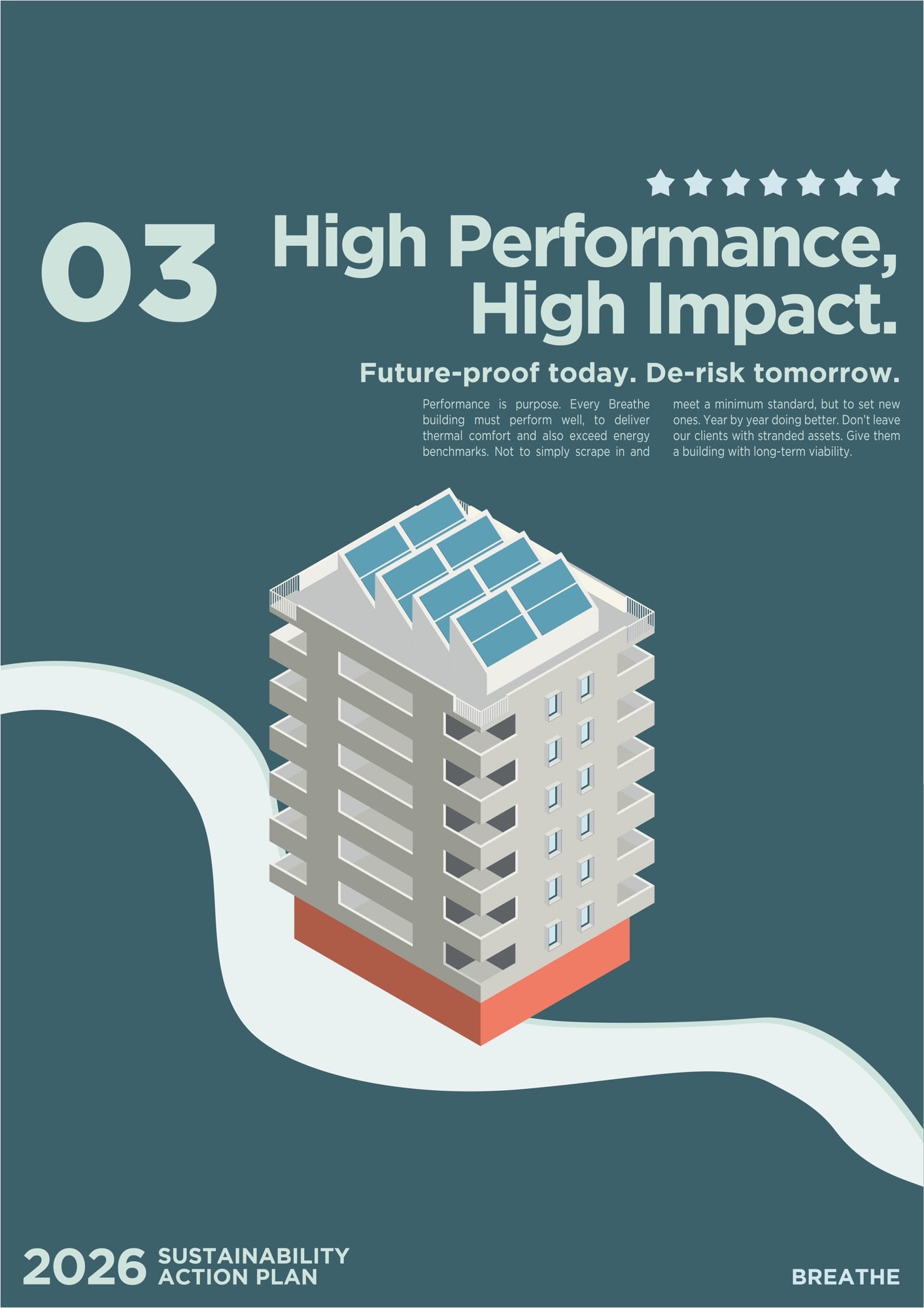
High Performance, High Impact
One of architecture’s most fundamental responsibilities is to provide shelter from the elements. To be comfortable in a building, whether in the height of summer or the depths of winter, is not only a priority for today, but is an ancient feature of architecture. Seen in this light, postwar cheap energy that bred buildings that depended heavily on power-hungry heating and cooling is the exception to a long history of architecture, where good design did a better job of designing for year-round comfort. That, and a pragmatic seasonal attitude to ‘rugging up’ for winter.
Thermal assessment is, therefore, much more than a tick box exercise or a matter of technical compliance. It is a design tool. Good design means a comfortable and controlled, thermally efficient building. Bad design means an uncomfortable building that pin-balls between too hot and too cold.
This is how we should approach high-performance design—simply good design, with NatHERS as our key tool in the transition to low-carbon, climate-adapted building. In practical terms, this means completing an early energy rating benchmark and a preliminary rating prior to town planning. This multi-phase energy rating process will be an integral part of our design and project delivery process moving forward.
While the industry minimum is currently 7 NatHERS stars, our minimum standard is 7.9 NatHERS stars. This is not a set-and-forget, but must be a rolling target of improvement, year by year. Next year our minimum standard will be 8 NatHERS stars, as we ratchet an annual increase of 0.1, year on year. Exceeding the minimum is the only way to aim for climate resilience, while recognising the unavoidable gap between predicted performance and as-built reality.
This is our ‘sweet spot’ balancing high performance building envelope against commercial viability. Or, to put it another way, balancing life-time operational costs against up-front capital expenditure. Mandatory energy consumption reporting is only a matter of time. Any client wanting to future-proof their asset value needs to take that balance seriously.
Build Less, Give More
Architecture and material excess are too often best mates. Perhaps this is what comes of design fees indexed against construction cost. Yet this attitude is the opposite of ethical practice.
Interrogate your brief and instead of asking what can I add, ask what can I take away? Educate your client. Ask, can we do this a different way, a better way? Be tenacious, do not accept the status quo. Substance over style. Every time.
In practical terms, this means reducing big ticket items, like basement carparks, the second bathrooms and unnecessary linings and finishes. Excise all flabby space. Design structures to be efficient and let gravity be your guide, taking your loads straight down to ground. Put heavy things on the ground not in the sky. Choose the right materials, fit for purpose. Aluminium is high in embodied carbon, but it doesn’t rust. So use it where necessary, sparingly, typically for external uses.
Promote others doing good and protect what goes into our product library. Ask suppliers the tough questions and be vigilant of ‘greenwashing’. If all suppliers manufactured using recycled content, renewable energy and EV transport then a carbon neutral building would be so much easier. So, if there is only one carbon neutral tapware product, then we can only specify one tap. The same for carbon neutral brick. Take the rest off the table. They are just more of the problem.
Where possible specify natural products, like timber, stone, hemp, clay brick, rammed earth, compressed strawboard. The closer to its natural state, the less manufacturing and less carbon. The closer something is produced, the less carbon miles. Trees extract CO2 from the atmosphere and lock it into the structure of the tree trunk as they grow. Swap steel for timber wherever possible.
Finally, identify if you are losing the battle early. See it, acknowledge it, and call for reinforcements. Breathe has decades of experience ready to come to your side, to meet with the client with you to see if the important things can be defended.
We’re stronger together.
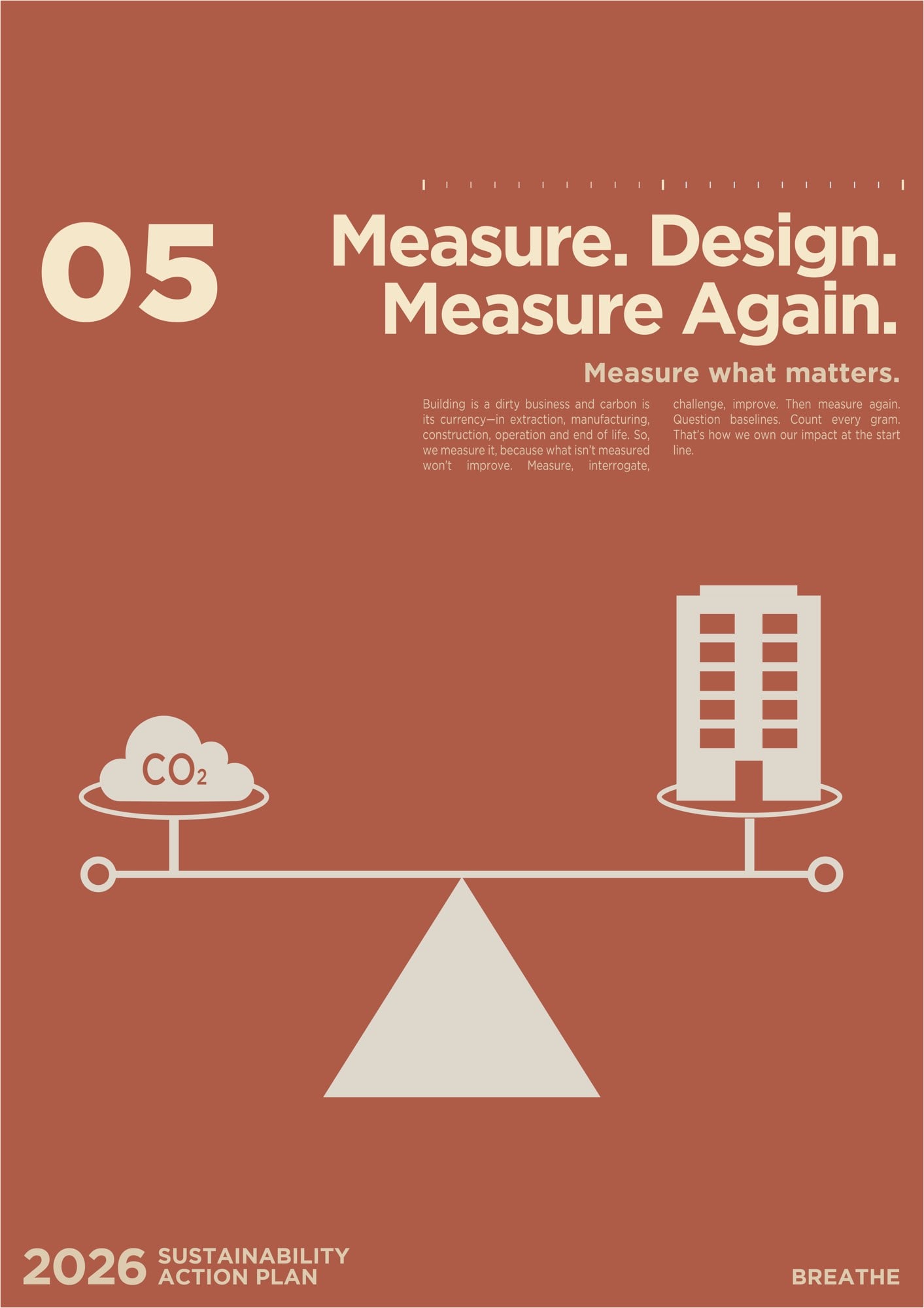
Measure. Design. Measure Again.
When it comes to measuring the materials we use in our buildings there are many things that matter. Water use, resource depletion and toxicity levels all matter, and can be measured, assessed and improved. When it comes to climate and the sustainability of our planet, however, nothing competes with greenhouse gases. And while the list of toxic gases that damage our atmosphere is long, carbon dioxide rates highest in its impact on our climate.
Sadly for the construction industry, the measuring of carbon emissions in buildings makes for a depressing read. Carbon dioxide is emitted during material extraction and processing, during construction and fabrication, over the time of the building’s use and at what is conventionally understood to be the end of its life (see priority 6).
At Breathe we are committed to measuring carbon emissions with an urgent mission to reduce them over time, ultimately to zero. If we don’t measure, we don’t know where the problems lie. If we don’t know where the problems lie, we can’t fix them.
Every Breathe project, regardless of scale or type, must have a Life Cycle Assessment completed at concept design stage. Once measured, interrogate it. Seek a second opinion. Interpret it. Then use it as a tool to do better. To use less. Then, measure again.
Waste has a hundred reasons, and no excuse.
Full Circle
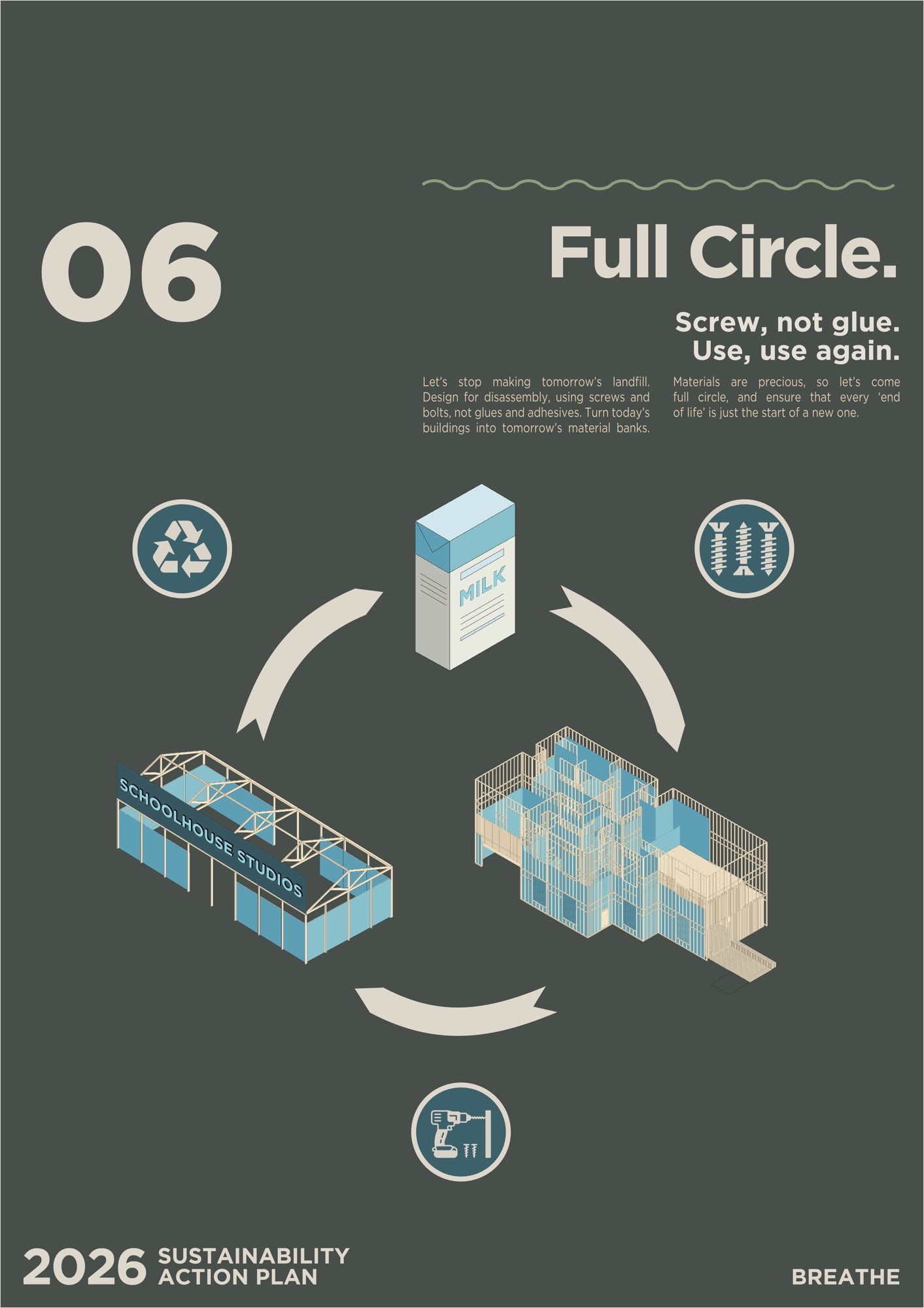
The days of take, make and dump are over. Any practice that continues to swell the skips and landfills of this world is categorically unsustainable. Yet the moment you use welds and adhesives—two very common construction processes—you are compromising the future use of the materials you are using. ‘Circularity’ is here, and it means changing this ingrained and wasteful attitude. Swap adhesives for screws, bolts and clips, allowing for disassembly when the building is ready for its next life. Specify materials that can be refurbished or reused when needed. Avoid hybrid or chemically bonded materials that through their very manufacture guarantee their future as landfill.
This is the tip of the circularity ice-berg. Circularity also means selecting durable materials, designing adaptable spaces, specifying standardised components, ensuring accessible connections, maintaining clear material documentation, minimising waste during construction and thinking creatively of how materials can retain value beyond a single life cycle. These practices must become first nature, not a secondary consideration. Baked into your creative design thinking, not laboured over as a constraint.
While this is essential for all our work, it is particularly important for interior projects, where lifespans are typically shorter and there can be a greater tendency towards speed and taking short-cuts.
Designing buildings to be flexible over the long-term means designing for long service lives, that anticipate future climate, use changes, and evolving regulations. This way we can reduce premature demolition and replacement. Design floor plans for replication and flexibility. Ask whether modularity is an option. Design non-load-bearing internal walls, which enable your designs to evolve instead of being demolished.
Done right we will leave a legacy of material ethics that might just outlive us. We will enable future generations to continue to drive down carbon emissions, long after we have finished our work.
Stop designing tomorrow’s landfill. Start designing tomorrow’s material banks.